
Autonomous infrastructure,
solved.
OTTOYARD is the physical and intelligence layer for autonomous fleets. We pair AV-native depots with the orchestration system that runs them, using AI to optimize logistics, dispatch, and energy economics, and enable fleet scale across the Southeast.
The full AV operations stack, by OTTOYARD.
Autonomous fleets need two things working in lockstep: AV-native depot infrastructure where vehicles start and end their day, and the intelligence layer that decides what happens at every site, every shift. OTTOYARD designs, deploys, and operates both as one integrated platform.
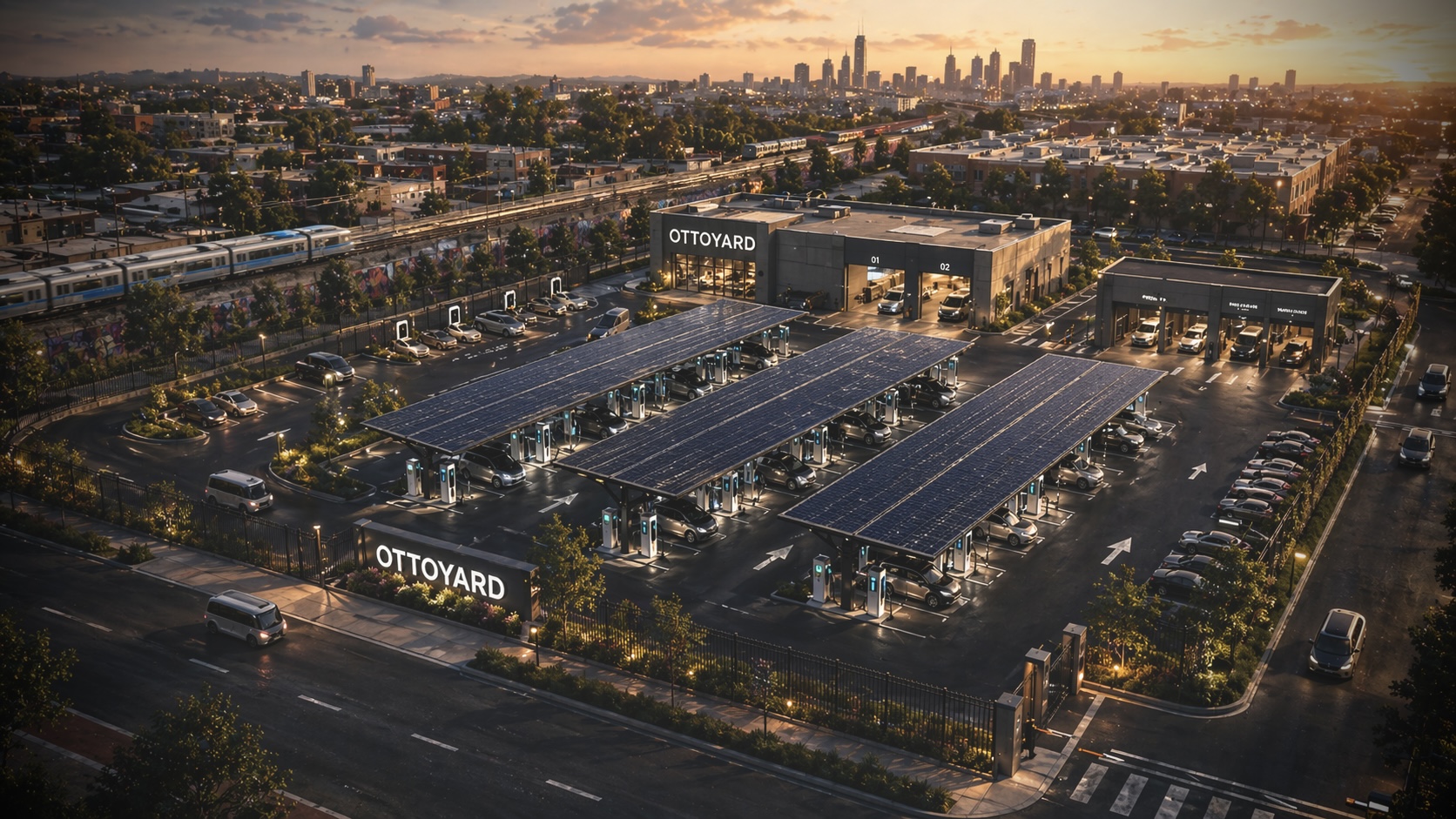 DEPOT · NETWORK · v2026/ AV-NATIVE
INFRASTRUCTURE
Owned, modular AV depot networks.
OTTOYARD acquires, designs, and operates AV-native depots: the parcels, utility ingress, energy storage, modular charging, calibration bays, and dispatch lanes that autonomous fleets need to actually run revenue routes 24/7.
- Owned parcels, primary + secondary SE metros
- 5 to 10+ MW utility ingress, BESS-backed
- Modular: 40 to 280 vehicles per site
- Service, calibration, and dispatch on one footprint
INTELLIGENCE
Real-time orchestration across every site.
OTTO-Q is the proprietary orchestration system that sequences every depot decision in real time, reconciling ML-scored optimization against deterministic operating rules so fleets get throughput and safety from the same engine.
- Two-layer architecture (rules + ML scoring)
- Predictive arrival, dwell time, and queue forecasting
- Cross-fleet, cross-OEM dispatch protocol
- OrchestraAV™ (operators) + OTTO-PULSE™ (depot)
Three problems gating commercial AV deployment.
Every operator running autonomous fleets at scale runs into the same three failures. OTTOYARD is engineered around them, and ships eight concrete things that resolve them.
SITE SUPPLY
Operators need 5 to 10+ MW parcels, near operating zones, with municipal cover. Land at this scale doesn't exist as a product. Operators source it ad hoc, lose 18+ months per metro, and end up with depots that don't load-balance against their own routes.
ENERGY ECONOMICS
Without energy storage, peak-rate exposure dominates the bill. Without orchestration, charging windows collide. Operators pay premium $/kWh for power they can't shift, and stalls sit idle through every off-peak window.
DWELL TIME + UTILIZATION
Dwell time exceeds 4× ICE turnaround once charging, detail, sensor calibration, and tire/brake checks are sequenced one at a time. Every parked minute is revenue surrendered and depreciation absorbed.
HOW WE SOLVE IT
One operator. Every layer.
OTTOYARD owns and operates the parcels, the energy economics, the service infrastructure, and the OTTO-Q orchestration engine that decides between them.
Fleet partners plug into a single integrated layer. Engineered for autonomous duty cycles, priced like utility infrastructure, and instrumented at aerospace tolerances. Every action is traceable, repeatable, and auditable to an OEM safety review.
▸WHAT WE SHIP · 08
01 / 08
AV-NATIVE DEPOTS
Owned parcels with engineered utility ingress, modular charging, and energy storage. Built to AV duty cycles, not retrofitted from passenger sites.
02 / 08
ENERGY ECONOMICS
BESS arbitrage, time-of-use offset, and OTTO-Q-managed demand mitigation deliver a flat sub-peak blended rate to fleet partners.
03 / 08
SERVICE + CALIBRATION
Detail, diagnostics, sensor calibration, and tire/brake handled in parallel bays, not serial. Dwell time shrinks against the benchmark, not the clock.
04 / 08
OTTO-Q ORCHESTRATION
Two-layer engine: deterministic operating rules below, ML-scored optimization above. Auditable safety floor with self-improving throughput.
05 / 08
ORCHESTRAAV™
Web, tablet, and mobile dashboard for fleet owners and operators. Vehicle health, scheduling, incident routing, and the OTTOCommand™ AI co-pilot.
06 / 08
OTTO-PULSE™
Field-ops platform for depot technicians and managers. Stall events, task completion, OTTO-Q visualization. Tablet-first, web and phone capable.
07 / 08
OEM + FLEET API
Open dispatch protocol, telemetry ingest, and labeled-event return feed. Plugs into OEM and operator stacks rather than replacing them.
08 / 08
REGIONAL NETWORK
Footprint across primary and secondary Southeast metros. The operating fabric every OEM will need in the markets none of them will build solo.
Depot infrastructure, engineered for autonomy.
OTTOYARD depots are modular, AV-native, and engineered around how autonomous fleets actually behave. Not retrofitted from passenger-vehicle facilities. Each parcel is an operating site that fleets, OEMs, and utilities can dock against.
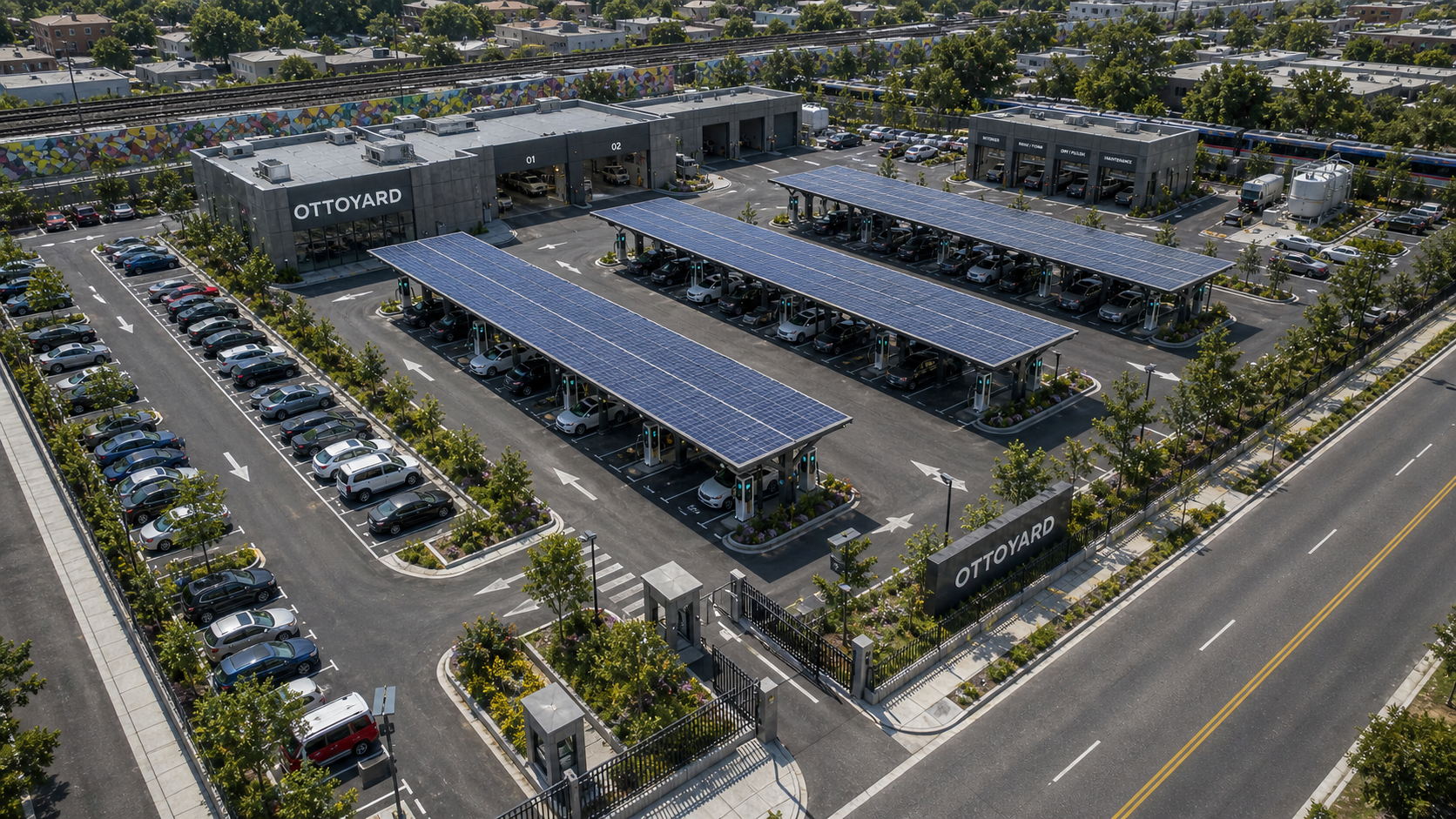 DEPOT · TYPICAL · v2026/ AERIAL
5 to 10+ MW
40 to 280 VEH
1.5 to 9 MWh
0.5 to 10+ ACRE · MODULAR
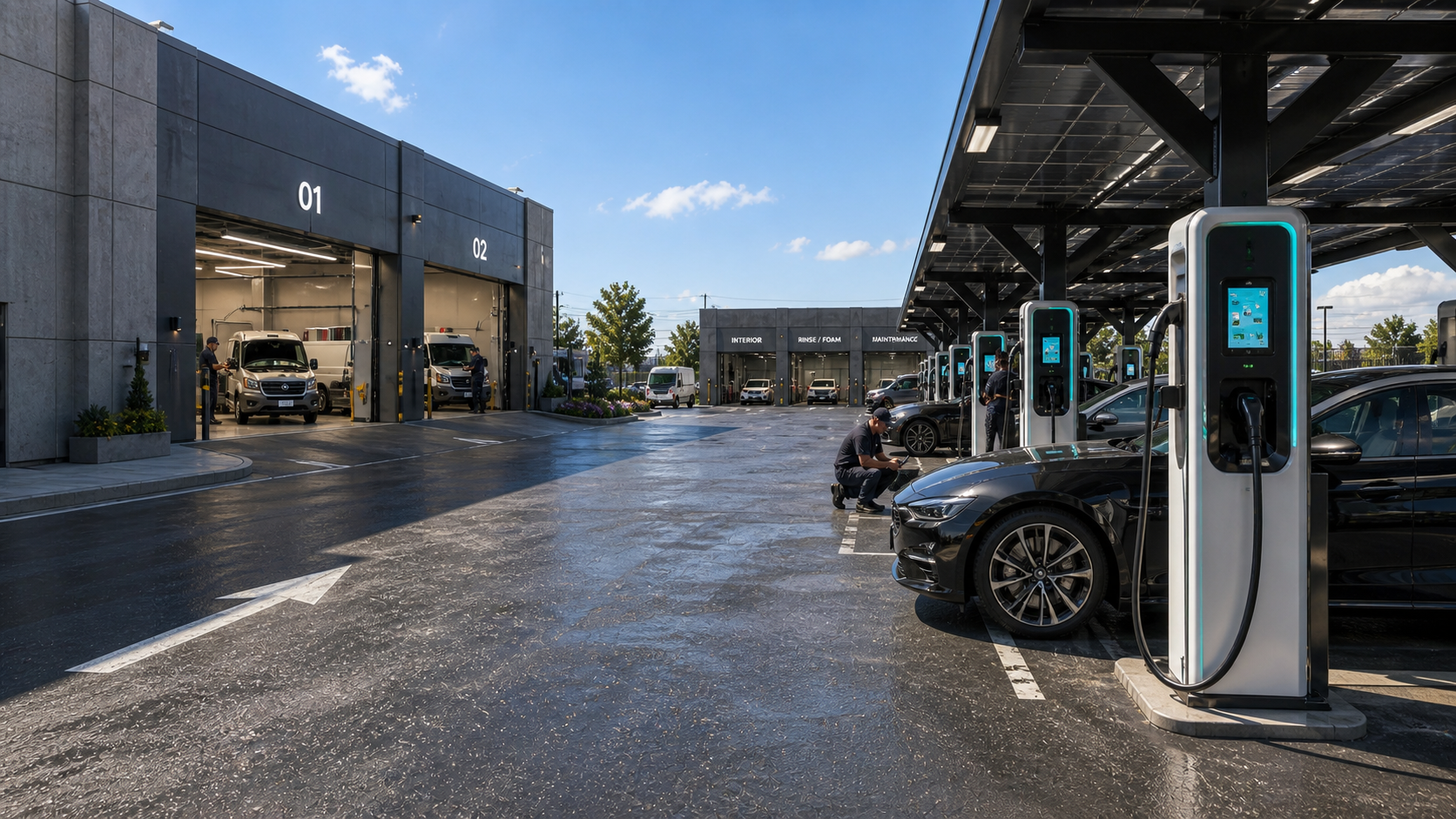 01 · CHARGING
DC fast-charge stalls, AV-shaped
Stall geometry, cable routing, and connector positioning designed around AV approach lanes. Power distributed through OTTO-Q so concurrent sessions never collide on the demand-charge window.
- 150 to 350 kW per stall
- Thermal-aware sequencing
- Auto-handshake with dispatch
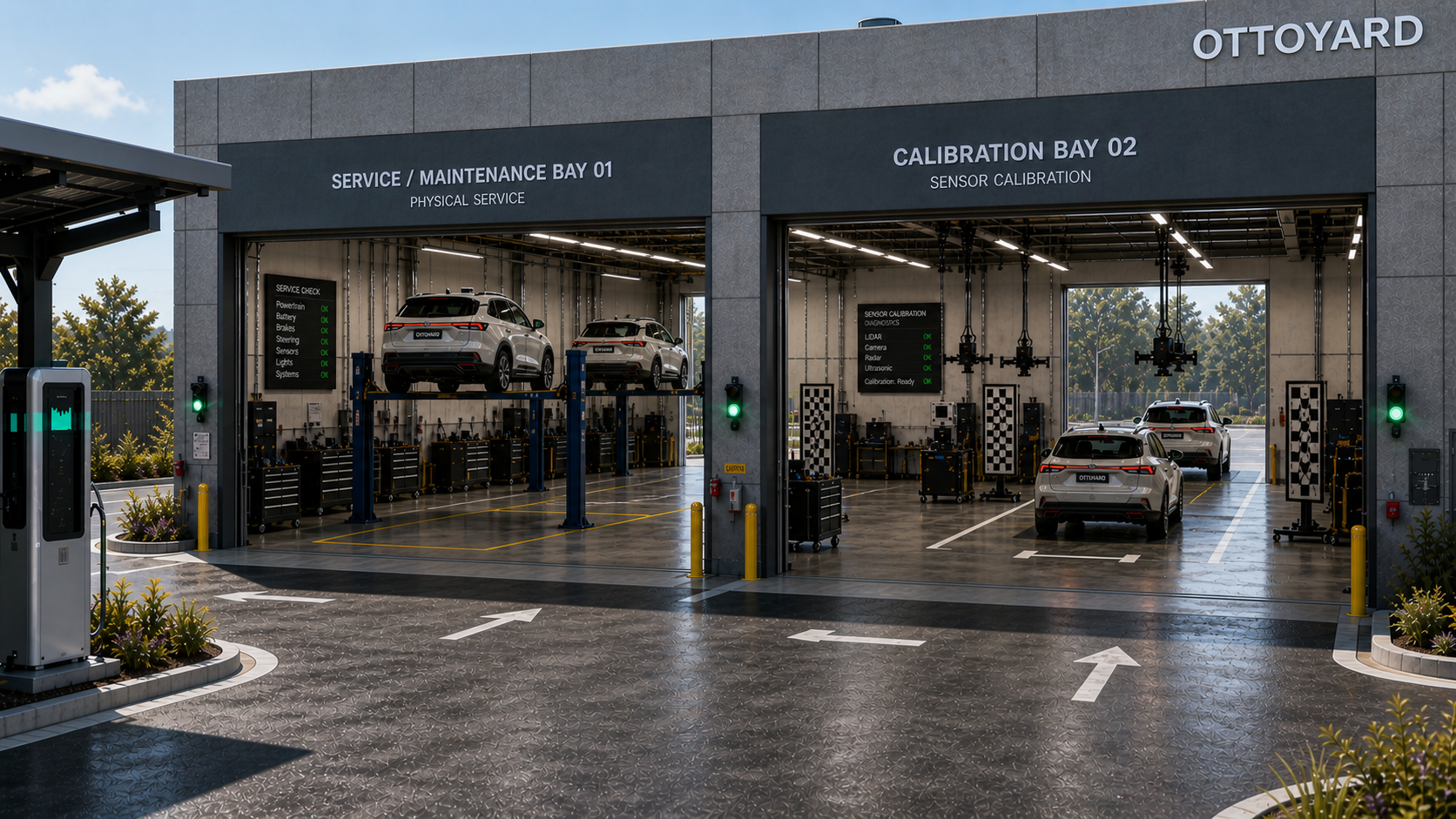 02 · SERVICE + CALIBRATION
Parallel bays for AV duty cycles
Maintenance, sensor calibration, and physical service handled in dedicated parallel bays, not serial. Service time stops being additive against revenue hours.
- Calibration boards + ADAS rigs
- Tire, brake, fluids
- Detail + interior reset
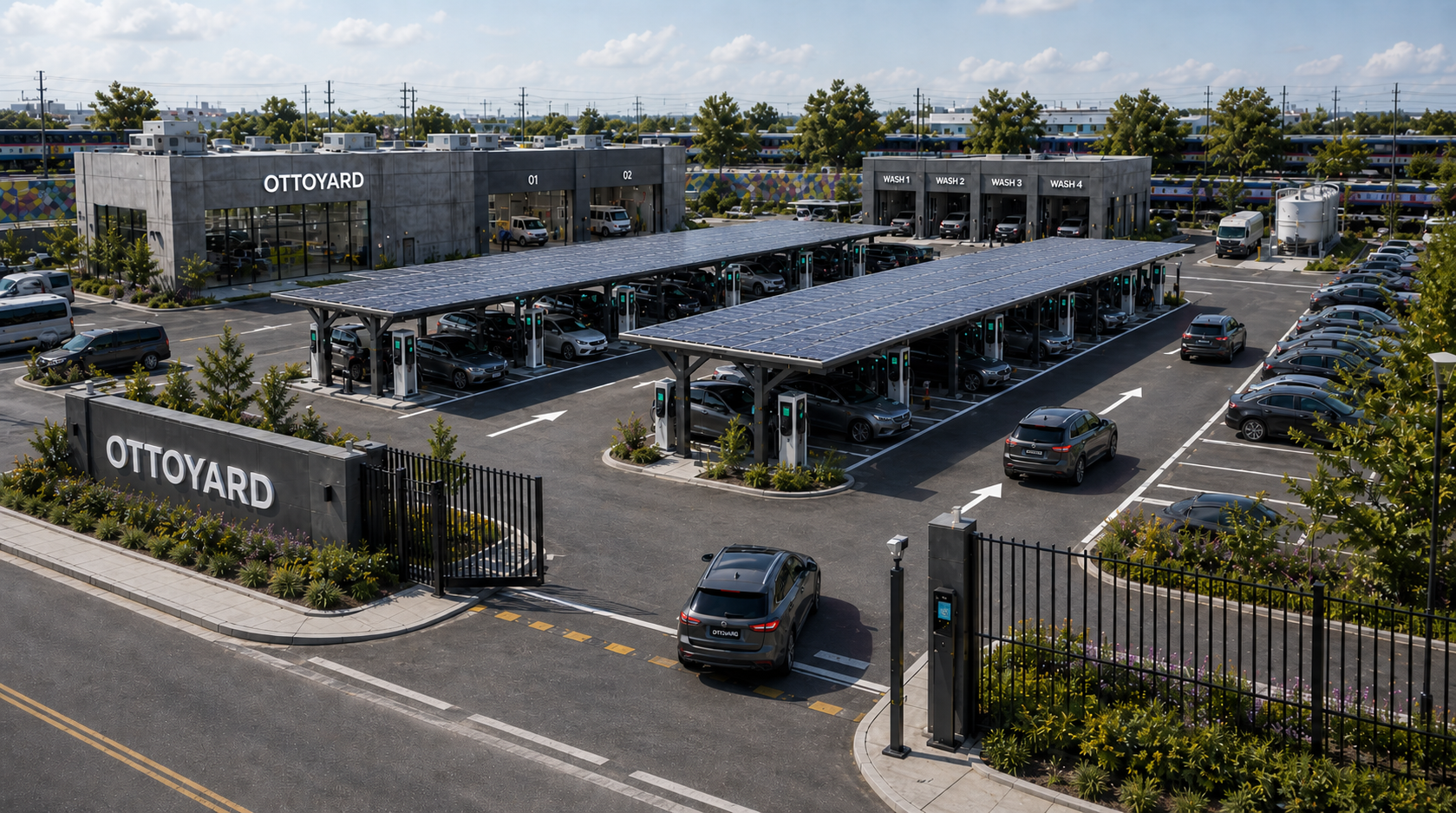 03 · ACCESS + DISPATCH
Controlled ingress, sequenced egress
Gated, monitored entry with vehicle handshake on arrival. Departure lanes prioritized against live demand, queue depth, and operator service-level commitments.
- Live ANPR + vehicle handshake
- Per-fleet dispatch lanes
- OttoResponse incident escalation
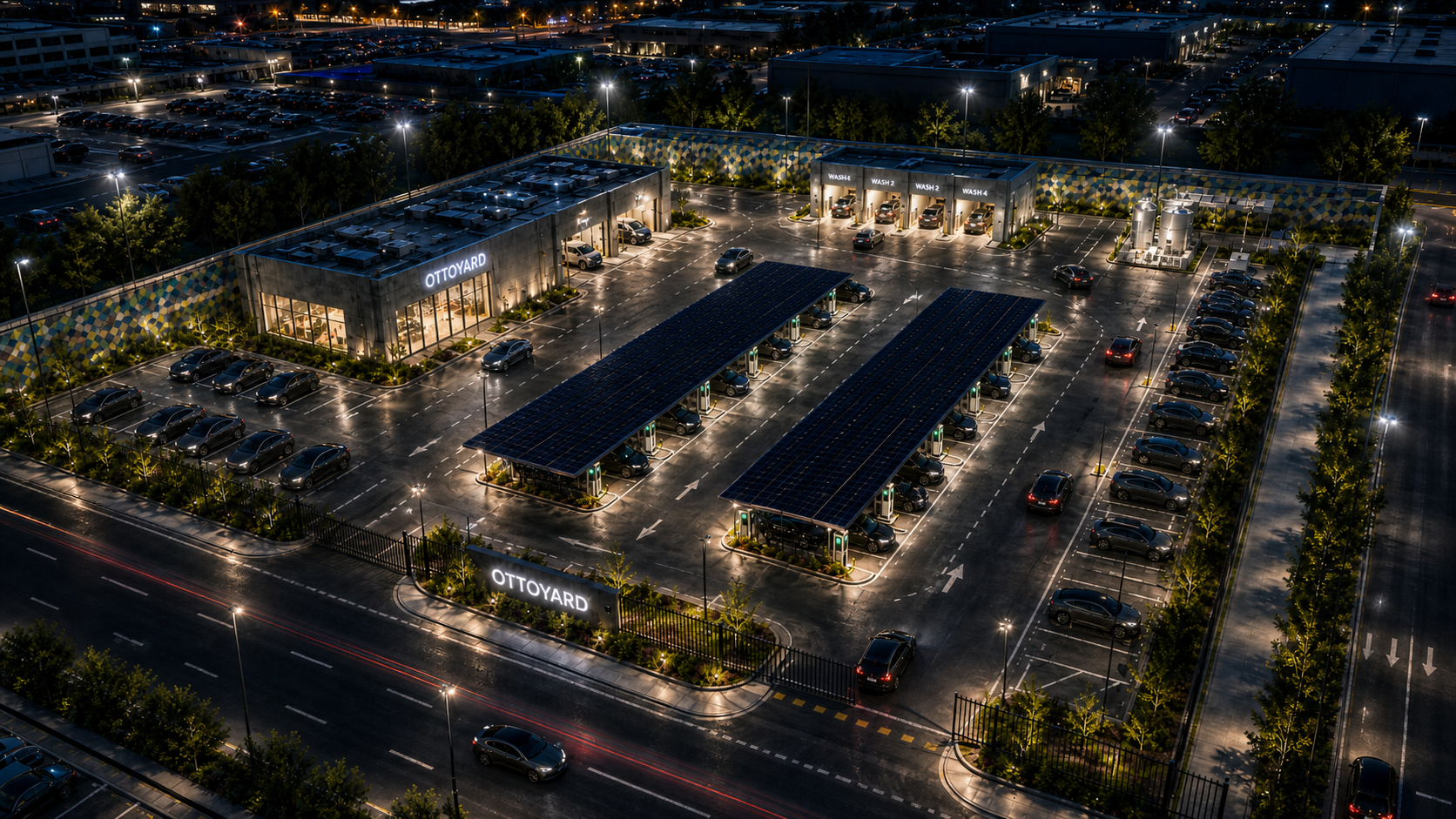 04 · 24/7 OPERATIONS
Designed to never close
Lighting, drainage, ventilation, and ops cadence designed for continuous operation. A small on-site office handles depot ops only. No retail, no public, no lounge.
- Continuous shift coverage
- On-site depot ops office
- AV-only, no public charging
ONE BLUEPRINT · EVERY METRO
Build once. Deploy everywhere.
Stall blocks, charging modules, BESS skids, and service bays are pre-engineered units. A 40-vehicle pilot site and a 280-vehicle anchor site share the same parts, the same operating runbook, and the same OTTO-Q logic. Only the count and the parcel change. New metros come online without re-design.
Lower blended $/kWh, at any demand level.
Regardless of total energy demand or consumption, OTTOYARD serves a lower blended $/kWh to fleet partners than competitors can offer. The math is the moat: BESS arbitrage, time-of-use offset, and OTTO-Q demand mitigation working together as a single energy posture.
WHY MORE
Aggregated demand unlocks utility-scale rates.
OTTOYARD signs interconnect agreements at depot scale, not vehicle scale. Volume reframes the tariff conversation entirely.
WHY LESS
BESS shifts every kWh out of peak.
On-site energy storage absorbs midday and overnight off-peak power, then discharges during peak windows. Fleet sees a flat sub-peak rate.
WHY DURABLE
OTTO-Q levels load before it lands.
Charging is sequenced across the network so peak demand is offset before it hits the grid, preserving headroom and protecting margin.
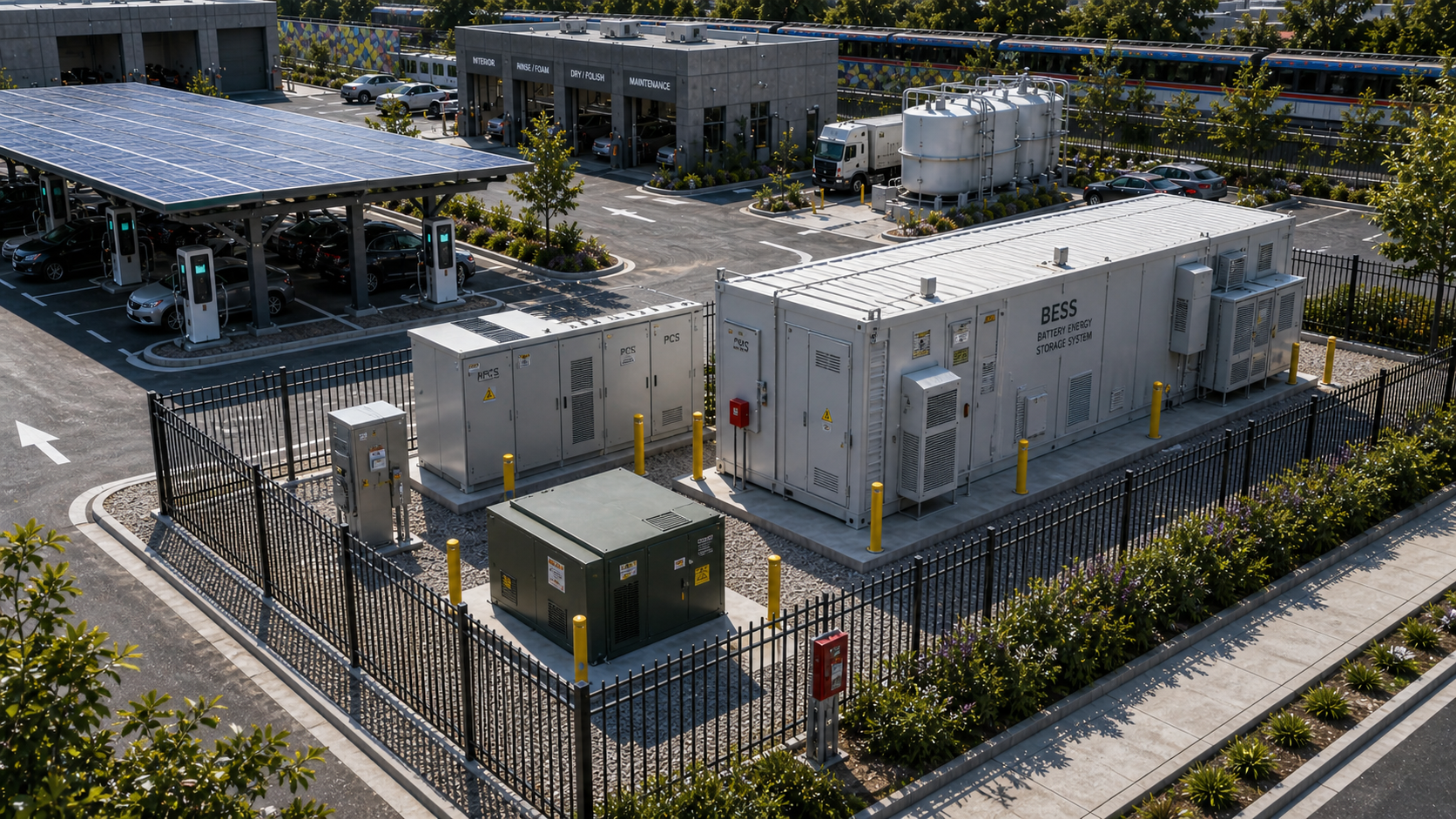 BESS · ON-SITE STORAGE/ DISPATCHABLE
ON-SITE ENERGY STORAGE · BESS
The battery is the lever.
Every site runs an on-site BESS sized to its tariff structure and OTTO-Q load profile. It absorbs cheap kWh (overnight grid, midday solar) and serves it back during the windows that would otherwise blow up a demand-charge bill.
One engine. Two layers. Complete optimization.
OTTO-Q is the proprietary orchestration layer that decides every depot action across every fleet, reconciling ML-scored optimization against deterministic operating rules. Surprises happen across charging, calibration, and dispatch. We counter them safely, every shift, on a system that gets sharper the longer it runs.
THE BROAD CASE
A safety floor that scales itself.
OTTO-Q is built on a deterministic, rules-based core. Every vehicle entering a depot is evaluated against the same hard constraints: state of charge, scheduled departure, stall availability, charger thermal state, current demand-charge window, and BESS headroom. This core decides what is physically and operationally possible. Every decision it makes is traceable, repeatable, and auditable.
Sitting above the deterministic core is a scoring layer that ranks every allowed action in real time and re-scores as conditions change: predicted arrivals, congestion, stall utilization, thermal derating, time-of-use pricing, BESS dispatch opportunity, and forecasted demand-charge windows. Where the rules engine asks what is allowed, the scoring layer asks what is optimal, and grades its own outputs against actual outcomes so the model gets sharper with every shift.
ASCORING LAYER
ML ranks options by expected payoff.
Soft, continuous, self-improving. Asks what is optimal right now.
- thermal derating curves
- predicted arrivals + congestion
- stall utilization curves
- time-of-use energy pricing
- BESS dispatch opportunity
- forecasted demand-charge windows
BRULES LAYER
Deterministic. Discrete. Auditable.
Hard constraints. Asks what is allowed. Filters every scoring output before it can become an action.
- state of charge
- scheduled departure
- stall availability
- charger thermal state
- current demand-charge window
- BESS capacity headroom
⨯ RECONCILE
Best allowed action wins.
SCORE × ALLOWED
▸ DECISION · GO
Dispatch.
- traceable
- repeatable
- auditable
FROM INPUT TO ACTION · 5 STAGES
Every charge, every calibration, every dispatch.
The pipeline runs continuously. New telemetry triggers a re-score. A re-score triggers a new decision. Every decision is reconciled against the rules layer before it ever reaches a vehicle.
INGEST
telemetry · market · plans
AGGREGATE
normalized state model
PREDICT
arrival · demand · queue
DECIDE
sequence · reserve · price
DISPATCH
fleet · grid · operator
ML-ONLY
Optimizes well, fails unsafely.
ML systems chase utility without a discrete safety floor. Fast in the average case, dangerous in the tail. OEM safety teams don't sign off.
RULES-ONLY
Safe, but slow and brittle.
Pure rules engines can't price energy or rank options against live conditions. You get an auditable system that leaves money on every shift.
▸OTTO-Q
Reconciled. Self-improving.
Rules first, scored above. Throughput rises with every shift the model sees, while every action remains explainable to a regulator or an OEM.
CLOSING THE LOOP
Every action writes back to the model.
Reconciliation produces labeled outcomes. Outcomes train the next score. Throughput, energy economics, and uptime improve the longer the network runs. The moat compounds with every vehicle, OEM, and site we serve.
FLEET UPTIME
0%Vehicle-hours available against vehicle-hours scheduled, network-wide.
DWELL Δ vs BENCHMARK
−0%Reduction in average AV dwell time vs. unorchestrated comparable depots.
$/kWh DELIVERED
↓ 0%Blended energy cost served to fleets after BESS arbitrage and demand offset.
MEAN RESPONSE
0sTime from vehicle ETA confirmation to assigned stall and sequenced action.
System intelligence, shaped to each role.
Two interfaces, one engine. OrchestraAV is the operator-facing layer for fleet owners, OEM field-ops managers, and (eventually) retail AV owners. OTTO-PULSE is the depot-facing layer for technicians, shift managers, and the on-site crews that keep every site running 24/7. Both surfaces share the same data model, the same operating rules, and the same predictions, exposed at the grain its audience actually uses.
AFOR FLEET OPERATORS
OrchestraAV™
Web, tablet, and mobile dashboard for fleet owners, OEM field-ops managers, and (eventually) retail AV owners. Vehicle health, scheduling, incident routing, and the OTTOCommand™ agentic co-pilot, all on top of the live OTTO-Q state model.
- Fleet- and vehicle-level telemetry, live
- Scheduled service · detail · calibration
- OTTOW™ + OttoResponse™ workflows in-line
- OTTOCommand™ agentic AI fleet manager
- Hard-push override of OTTO-Q recommendations
- Web · tablet · mobile (tablet-and-web first)
Future fitThe same surface scales down to a 10-vehicle private fleet without re-design. As OEMs ship retail AVs, OrchestraAV is the operating seat their owners log into.
OTTOYARD Nashville Flagship
Powered by OTTO-Q Technology
34
Available
1
Occupied
0
Out of Service
Energy Analytics
84% Eff.Net Energy Usage: 5,196 kWh
BFOR DEPOT OPS
OTTO-PULSE™
Field-ops platform for depot technicians and managers. Stall events, task confirmation, service runbooks, and a live visualization of what OTTO-Q is doing, and why. Tablet- and web-first, phone-capable for the floor.
- Stall ingress / egress confirmation
- Task completion + service-runbook compliance
- OTTO-Q decisions visualized in real time
- Per-technician + per-shift performance views
- OTTOW™ + OttoResponse™ workflows in-line
- Tablet · web · phone (tablet-and-web first)
Why two surfacesA fleet-owner dashboard and a depot-floor app have different half-lives, different audiences, and different inputs. Same engine beneath, different grain on top. Neither product is the other wearing a costume.
INCIDENT + EVENT INTELLIGENCE
Two response systems, both running through OTTO-Q.
Single-vehicle anomalies and metro-wide events have completely different operating profiles. OTTOYARD runs a dedicated workflow for each, surfaced inside both OrchestraAV and OTTO-PULSE so operators and depot crews see the same picture in real time.
SINGLE-INCIDENT RESPONSE
OTTOW™
Per-vehicle fault, hazard, or anomaly. Auto-routes to the nearest tech, bay, or safe staging position. Threshold-aware escalation and live status across operator, depot, and dispatch in seconds.
- Vehicle-level fault routing
- Auto-assigned tech and bay
- Live status to operator + depot
FLEET-SCALE EVENT MANAGEMENT
OttoResponse™
Severe weather, mass-incident, or public-safety lockdowns. Coordinated safe-return protocols across the fleet, multi-depot rebalancing, shelter staging, and metro-wide handoff with operator and OEM stakeholders.
- Coordinated safe-return protocols
- Multi-depot rebalancing + shelter staging
- Operator + OEM stakeholder handoff
BOTH WORKFLOWS RUN INSIDE ORCHESTRAAV AND OTTO-PULSE · POWERED BY OTTO-Q · ALL ACTIONS LOGGED, AUDITABLE, AND TRACEABLE TO RESPONSE REVIEW
BEFORE A WHEEL TURNS · 100% IN SIM
Every shift, rehearsed first.
Before any OTTO-Q decision touches a real vehicle, it has already been rehearsed thousands of times in OTTO-Twin. We run scheduling, energy dispatch, and fleet composition against synthetic depot shifts in a physics-accurate digital twin. The same rules layer that runs in sim runs in production. Every decision is traceable, every outcome replayable, and new metros, new fleets, and new policies enter production having already weathered their stress tests.
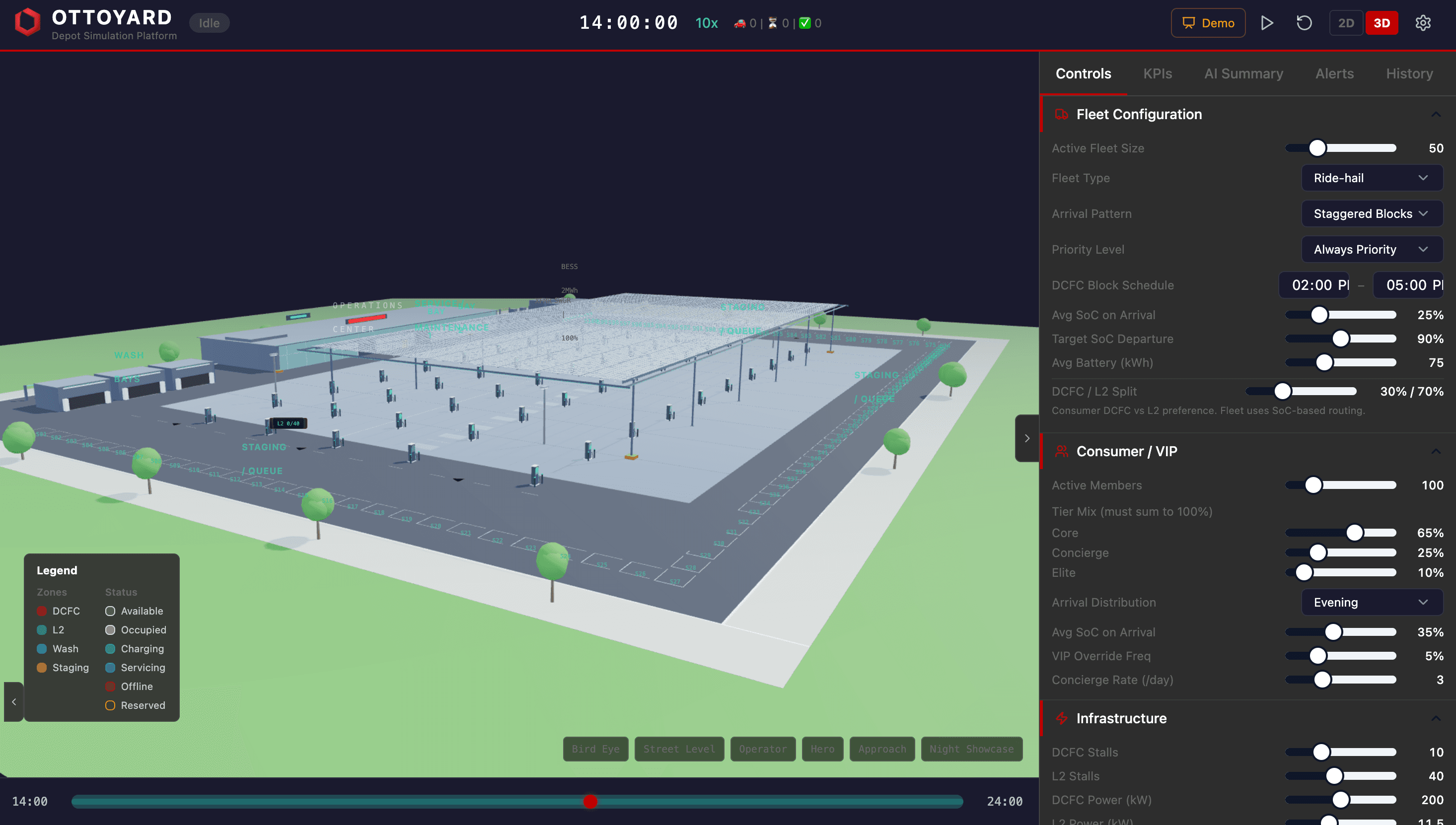
CFOR DEPOT VALIDATION
Configure. Run. Replay.
Every depot we build gets a live twin. Operators set fleet size, arrival pattern, charger mix, and BESS capacity, then watch OTTO-Q schedule against the rules layer in real time. KPIs, alerts, and AI-summarized post-runs are surfaced inline. The models that run in production are validated here first.
- Configurable fleet, arrival pattern, charger mix, BESS
- Live KPIs: uptime, turnaround, queue wait, BESS SoC
- Incident injection: charger faults, demand spikes, thermal events
- AI-summarized run analyses with bottleneck attribution
- Full run history with telemetry-grade replay
- 2D / 3D dual view, time-scrubbing, scenario presets
Scope todaySingle-depot scenarios with full OTTO-Q decision coverage. Multi-depot federated runs and hardware-in-the-loop on roadmap for the next release cycle.
DCOMPUTE PARTNER

cuOpt · Omniverse · Cosmos
Three NVIDIA technologies underwrite every OTTO-Q decision.
cuOpt solves every dispatch as a GPU-accelerated routing problem against live depot state. Omniverse renders the depot, charger, BESS, and traffic in OpenUSD with physics-accurate kinematics. Cosmos generates the long-tail scenarios our model trains against: demand spikes, thermal events, distribution shift, the conditions a fleet sees once a year and an OEM has to ship for. Together they let us validate, stress-test, and ship faster than any operator building a depot stack from scratch.
ROUTING
cuOpt
GPU-accelerated routing solver. Sub-5-second time-limit, 128 climbers, live depot state.
PHYSICS
Omniverse
OpenUSD physics runtime. Aligned with the Mega Omniverse Blueprint for facility digital twins.
SCENARIOS
Cosmos
World foundation models (Transfer 2.5, Predict 2.5) for long-tail synthetic scenarios.
This is how OTTOYARD scales with conviction. Every metro we open, every fleet we onboard, every policy we tune is weathered in the twin first. OEM partners and fleet operators dock against an operating layer that has already been tested at the scale they are scaling into, on the scenarios they care about most.
SECURITY · API · OEM SYNC
Built to plug into the partner, not replace them.
Open contracts, auditable access, and an integration surface that lets OEMs scale vehicles without re-platforming the ops layer behind them.
The fastest-growing region in the country.
The Southeast is where U.S. population growth, tech employment, and near-term AV deployment converge. Owning depot infrastructure across Nashville, Atlanta, Charlotte, Raleigh, Tampa, and Miami positions OTTOYARD as the operating partner OEMs and fleets dock against when they enter these markets.
U.S. ROBOTAXI MARKET
$0BProjected 2035, revised up from $7B
SOURCE · Goldman Sachs Research
GLOBAL AV FLEET
0MForecast 2035, from ~7K vehicles in 2024
SOURCE · Goldman Sachs Research
GLOBAL ROBOTAXI MARKET
$0BProjected 2035, across all metros
SOURCE · Goldman Sachs Research
DECADE OF U.S. POP GROWTH
0%Sun Belt share of total U.S. population growth
SOURCE · Moody's Analytics / Clarion Partners
TOP IN-MIGRATION METROS
0 / 15From Census 2023 to 2024, Carolinas to AR
SOURCE · Bush Institute / SMU analysis
WAYMO SE FOOTPRINT
0 METROSAtlanta live + 11 metros calendared by 2026
SOURCE · CNBC, December 2025
PHASE 01 · ANCHOR
Nashville → Atlanta corridor
Anchor depots in BNA and ATL with dedicated dispatch lanes between them. Initial OEM and fleet pilots run on this spine. Atlanta is already live with Waymo, with 11 more Southeast metros calendared by 2026.
PHASE 02 · PRIMARY
Charlotte · Raleigh · Tampa · Miami
Active site location search and outreach underway across the highest-density commercial AV markets in the Southeast. Each metro engineered to support ≥ 500 vehicles at network maturity, anchored by tech-employment and population growth.
PHASE 03 · SECONDARY
Memphis · Orlando · Birmingham · Knoxville · Jacksonville · more
Secondary markets are the long tail: smaller depots, OEM testbeds, and inter-metro relay sites that knit the network into a continuous fabric. Three of the top four U.S. tech-employment growth metros are in this band.
▸ FOR EARLY PARTNERS
Early partners get the cleanest path to metro entrenchment.
Owning the depot footprint means setting the operational defaults: which OEM dispatches when, how energy is priced, and how fleets compose across the corridor. Partners who anchor with us in 2026 and 2027 will be operating on infrastructure their later competitors are still trying to build.
08ECOSYSTEM · MOAT
OTTOYARD is the only integrated operator across the AV stack.
Fleet owners can see every detail about every vehicle through OrchestraAV. That isn't the headline. The headline is what sits behind that view: an integrated stack of owned parcels, structurally lower energy economics, and the OTTO-Q decision engine that orchestrates between them. The moat compounds with every shift the network runs.
LAND MOAT
Owned parcels, scarce supply.
5 to 10+ MW AV-grade parcels with utility access don't exist as a product. We're acquiring them outright across the Southeast: anchor metros first, secondary markets behind. New entrants compete against absent inventory.
DATA FLYWHEEL
Every shift sharpens the model.
OTTO-Q grades its own outputs against actual outcomes. Throughput, energy economics, and uptime improve the longer the network runs. The model gets harder to replicate with every vehicle, OEM, and site we serve.
ENERGY ECONOMICS
Sub-peak rate, compounding.
BESS arbitrage, time-of-use offset, and pre-emptive demand mitigation deliver a flat blended $/kWh that competitors cannot price-match without our scale and our scheduling layer. The longer fleets run, the wider the gap.
OEM-NATIVE
Plug in, don't replace.
OrchestraAV™ and OTTO-PULSE™ are designed to dock against existing OEM stacks, not displace them. We're the ops layer OEMs don't want to build, in markets they don't want to enter alone, on land they can't acquire fast enough.
CLOSING POSITION
Autonomous mobility is a once-in-a-generation infrastructure build. OTTOYARD is delivering the only complete answer: depots, energy, and orchestration as one integrated operating layer, ready to scale across every metro the future of autonomy touches.
09CONNECT
Build the network
with us.
OTTOYARD accelerates autonomous fleet deployment and optimizes every operation that runs behind it. Tell us where you fit (vehicle scale, operating zone, integration timing) and we'll come back with concrete next steps.